
The Game Before the Game
Football in the 1800s did not look like the polished, camera-ready sport fans know today. There were no towering stadium scoreboards, no radio broadcasts, no facemasks, no replay reviews, and no carefully scripted passing attacks. The earliest versions of American football looked more like organized chaos: a rough blend of soccer-style kicking, rugby-style running, college rivalry, muddy fields, and rules that were still being argued into existence. To understand 1800s football, you have to forget the modern image of quarterbacks dropping back in clean pockets, receivers sprinting through choreographed routes, and defensive backs studying formations on tablets. The game was still deciding what it wanted to become. It borrowed from English public-school football traditions, association football, and rugby, then slowly transformed into something distinctively American. The famous Rutgers-Princeton game of 1869 is often remembered as a starting point for college football, but even that contest looked far more like soccer than the modern gridiron game.
A: Not at first. Early games often looked closer to soccer or rugby before American rules developed.
A: No. Teams advanced through running, kicking, laterals, and physical formations.
A: Helmets were rare for much of the century, and early protective gear was extremely limited.
A: Players had minimal protection, and mass formations created intense collisions.
A: Walter Camp was one of the most important figures in developing the line of scrimmage, downs, and organized play.
A: Yes. College football was the main stage for most of the 1800s.
A: Players commonly wore wool sweaters, canvas jackets, trousers, stockings, and leather shoes.
A: No. Rules varied by school and region before standardization improved.
A: Football was evolving away from soccer and rugby influences, so goals, touchdowns, and kicks were revalued.
A: It created the foundation for the modern game’s rules, rivalries, strategy, and identity.
A Sport Born From Several Ancestors
The word “football” in the 1800s did not always mean one clear sport. Different schools and clubs played different versions. Some emphasized kicking. Others allowed carrying the ball. Some used round balls, others used oval balls, and many games were governed by local agreements rather than national rulebooks. This meant a team could travel to another school and discover that the basic expectations of play were different. That confusion was not a weakness; it was part of the sport’s evolution. American football developed in the space between soccer and rugby. Colleges such as Rutgers, Princeton, Harvard, Yale, Columbia, and later other major schools helped shape the rule changes that slowly separated football from its older cousins. By the end of the century, the game was becoming more structured, more strategic, and more recognizably American.
The Field Was Rough, Open, and Unforgiving
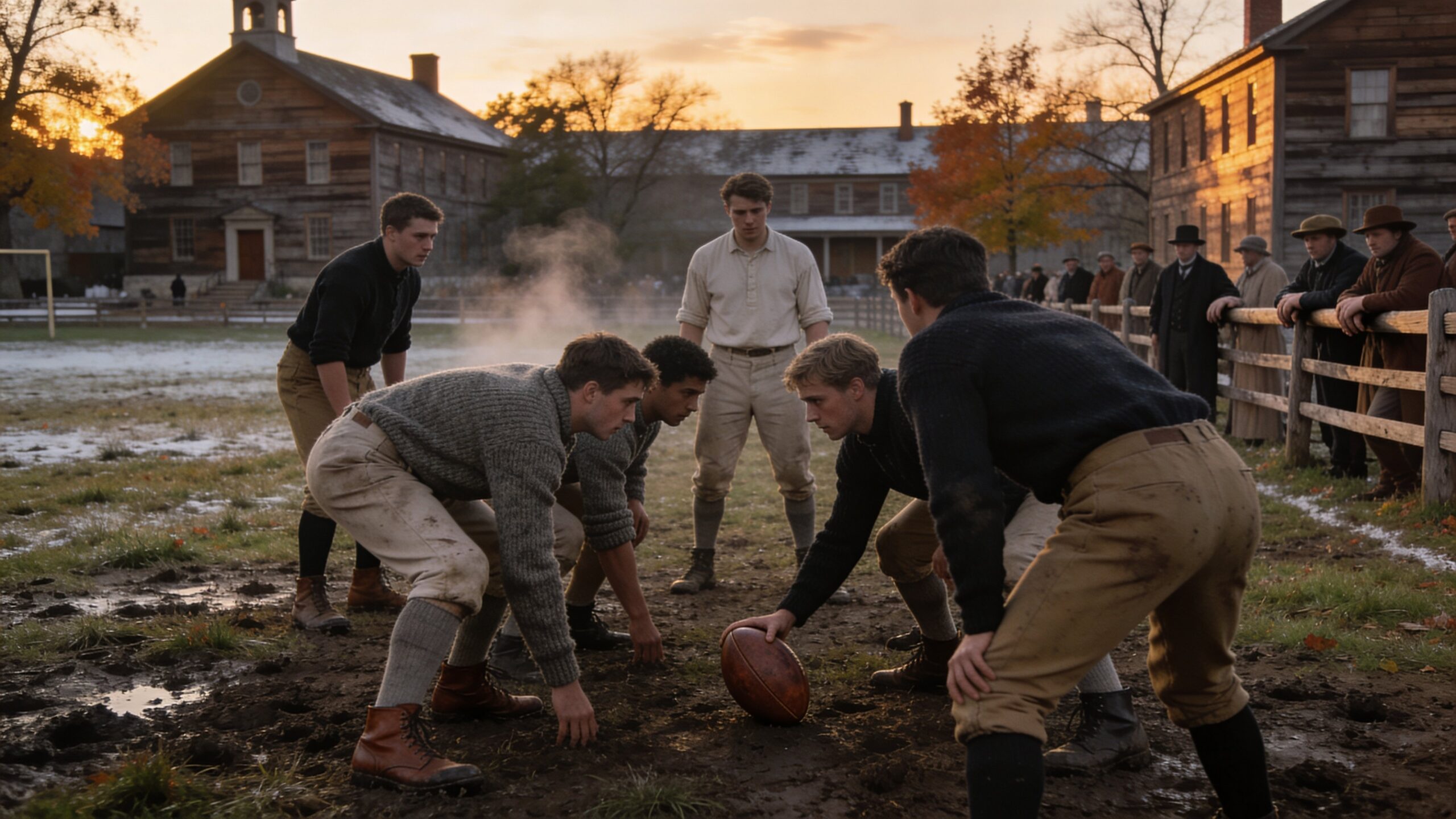
A football field in the 1800s was not the perfectly groomed surface modern fans expect. It could be uneven, muddy, frozen, dusty, or simply worn down by campus use. Lines were less standardized in the early years, and the visual identity of the gridiron had not fully arrived. The environment itself was part of the challenge. Bad footing shaped strategy. Mud slowed movement. Cold weather made the ball harder to handle. Players had to adapt to the ground beneath them as much as the opponent in front of them.
There were no domes, synthetic turf systems, heated benches, or advanced drainage designs. Spectators might crowd along the edges of the field, sometimes close enough to feel like part of the contest. Football had not yet become a fully packaged entertainment product. It was a public college spectacle, a test of nerve, and often a bruising display of school pride.
The Ball Was Different Too
The modern football is built for passing, gripping, spiraling, and precise control. In the 1800s, the ball was less standardized and more connected to rugby traditions. Its shape could vary, and as the game moved away from kicking and toward carrying, the ball’s form became increasingly important. A more elongated ball made running, tucking, and later snapping easier, but it was not yet the sleek passing instrument of the twentieth century.
Because the forward pass was not part of 1800s football, ball handling had a different personality. The ball was protected, pushed, kicked, carried, lateraled, and fought over. It was not launched downfield in graceful arcs. Offense was built around possession, territory, collisions, and controlled advances rather than explosive aerial strikes.
Players Looked Like Students, Not Armored Athletes
A football player in the 1800s would look shockingly underprotected to a modern viewer. Early players wore simple uniforms, heavy sweaters, canvas jackets, wool trousers, stockings, and leather shoes or boots. Protective equipment was minimal. Helmets were rare or nonexistent for much of the century. Shoulder pads, thigh pads, and modern facemasks were still in the future. A player’s toughness was often measured by how much punishment he could absorb with little more than fabric between his body and the collision. The lack of protection did not make the sport gentle. In many ways, it made the game more dangerous. Tackles, scrums, mass formations, and pileups could be brutal. Players collided without the safety systems, medical protocols, and equipment standards that shape modern football. Injuries were part of the culture, and the line between bravery and recklessness was often dangerously thin.
The Rules Were Still Being Invented
One of the most fascinating things about 1800s football is that many of the rules fans now consider essential were still being created. The line of scrimmage, the snap, the system of downs, team size, scoring values, and field structure all changed over time. Football was not handed down as a finished product. It was built through debates, experiments, committee meetings, rivalries, and the influence of powerful coaches and college programs.
Walter Camp, often called the “Father of American Football,” played a major role in transforming the sport during the late 1800s. His influence helped move the game away from rugby’s loose scrummage style and toward a more organized structure. The introduction of the line of scrimmage, the center snap, and downs gave football a stop-start rhythm that separated it from soccer and rugby. By creating controlled possessions and set plays, the sport became more strategic and more uniquely American.
There Was No Forward Pass
The absence of the forward pass may be the biggest difference between 1800s football and today’s game. Modern football is often built around quarterbacks, receivers, timing routes, deep shots, and passing efficiency. In the 1800s, none of that existed. Teams advanced the ball through running, kicking, laterals, and physical force. The game was less about spreading the field and more about winning territory through pressure.
This made football feel heavier and more compact. Formations were tight. Players often moved as masses rather than isolated specialists. Offenses tried to push, wedge, and grind their way forward. The sport rewarded strength, discipline, stamina, and collective movement. Instead of highlight throws, fans saw surges, tackles, scrambles, and punishing drives.
Strategy Was Physical, Not Flashy
Football strategy in the 1800s was real, but it was not flashy in the modern sense. Coaches and captains thought about field position, momentum, formations, and how to exploit weaknesses. However, without the forward pass and with fewer substitutions, the game demanded endurance and force. Strategy lived in the arrangement of bodies, the timing of rushes, the choice to kick, and the ability to wear down an opponent.
The famous mass plays and wedge formations of the late nineteenth century showed how tactical football could also become dangerous. Teams learned to concentrate power at a single point, sending blockers and runners together like a human battering ram. These plays could be effective, but they also raised serious safety concerns. The game’s growing violence eventually forced reform, but in the 1800s, brutality and innovation often moved side by side.
Scoring Was Not Always What Fans Expect
Modern football fans are used to touchdowns worth six points, extra points, field goals, safeties, and carefully tracked statistics. In the 1800s, scoring values shifted over time as the sport evolved. At different points, goals, touchdowns, and kicks carried different importance. Early versions of the game often placed more emphasis on kicking goals than on touchdowns as fans understand them today. This changing scoring system reflected a sport in transition. As American football moved away from soccer and rugby influences, the touchdown gained greater value and meaning. By the late nineteenth century, the structure of scoring was becoming more familiar, but it still had not settled into the fully modern form. The scoreboard told a story of experimentation.
The Crowd Was Close to the Action
Watching football in the 1800s was a very different experience from attending a modern game. There were no massive video boards, luxury suites, electronic sound systems, or branded entertainment segments. Spectators gathered around fields, often in informal arrangements. Students, alumni, townspeople, and curious onlookers created the atmosphere with their own voices, school songs, cheers, and raw enthusiasm.
The crowd was closer to the players, and the sport felt more immediate. A big rivalry game could stir intense emotion. College pride gave football its early cultural fuel. Even before professional football became important, the college game created loyalty, identity, and tradition. The crowd did not need fireworks or giant screens. The spectacle was the clash itself.
College Rivalries Built the Sport’s Identity
Football in the 1800s was largely a college game. Universities became the laboratories where rules changed, strategies developed, and rivalries grew. Games between schools carried social meaning. They were contests of strength, discipline, class identity, institutional pride, and regional prestige. A victory could echo across campus long after the final whistle.
These rivalries helped football become more than a pastime. They gave the sport drama, continuity, and tradition. Students cared because the team represented them. Alumni cared because the school’s reputation was on the line. Newspapers cared because the games produced conflict, personality, controversy, and spectacle. The sport grew because it attached itself to belonging.
The Game Was Dangerous and Controversial
Football’s rise was not smooth. By the late 1800s, critics were already worried about its violence. Serious injuries and deaths drew public attention. Some educators and reformers questioned whether the game belonged on college campuses at all. Was football building character, courage, and teamwork, or was it encouraging brutality under the banner of school spirit?
That argument became one of football’s defining tensions. Supporters believed the sport created toughness, leadership, loyalty, and discipline. Critics saw chaos, injury, and moral danger. The debate did not destroy football. Instead, it pushed the sport toward reform. The same violence that made football thrilling also forced rulemakers to rethink how the game should be played.
Newspapers Helped Turn Football Into a Spectacle
Long before television made football a national obsession, newspapers helped build its audience. Reports of big college games brought the action to readers who could not attend. Sportswriters described the mud, collisions, strategy, stars, controversies, and atmosphere. They helped transform local contests into public events.
The language of football began to grow alongside the game itself. Writers turned players into heroes, rivalries into dramas, and rule changes into talking points. As coverage increased, so did the sport’s importance. Football became something people followed, argued about, and anticipated. The press helped move it from campus fields into the wider American imagination.
Uniforms Were Practical, Heavy, and Simple
The clean, branded uniforms of modern football were far removed from the rough attire of the 1800s. Players often wore thick sweaters, canvas or moleskin jackets, long pants, stockings, and leather footwear. The clothing was chosen for durability more than speed or style. In muddy conditions, uniforms became heavy and uncomfortable. In cold weather, wool absorbed moisture and added weight. Team identity existed, but it was not expressed with today’s polished visual systems. Colors, stripes, and simple markings helped distinguish teams, but there were no modern logos, performance fabrics, or advanced tailoring. A player looked more like a rugged college athlete than a professional sports product. The uniform told the truth about the era: this was a hard, physical, imperfect game.
Positions Were Still Evolving
Modern football positions are highly specialized. Quarterbacks, running backs, wide receivers, tight ends, linebackers, safeties, edge rushers, and nickel corners all have distinct roles. In the 1800s, positions were less specialized and more fluid. As the rules developed, roles became clearer, but the game had not yet reached the complexity of today’s playbooks.
Players were expected to be tough, versatile, and durable. Substitution was limited compared with modern football, so athletes often played through fatigue. A player needed to block, tackle, run, kick, and endure. The idea of separate offensive and defensive units had not yet fully arrived. Football was a whole-body, whole-game commitment.
The Pace Was Slower but the Contact Was Fierce
A modern viewer might find 1800s football both slower and more violent. Without passing attacks, hurry-up offenses, television time structures, and specialized formations, the game often moved in grinding waves. Drives were battles of territory. Progress could be slow and exhausting. The excitement came not from constant scoring but from the struggle for control.
The contact, however, was fierce. Players collided in dense formations, often without meaningful protection. Every yard mattered because yards were hard to win. Momentum could shift through a tackle, a kick, a fumble, or a successful rush. The game was less open than modern football, but it had a raw intensity that made it gripping to those who watched.
Coaching Was Becoming a Power
In the earliest phases of football, captains and players had enormous influence over strategy. As the sport grew more complex, coaching became more important. Late nineteenth-century football saw the rise of organized systems, planned formations, and more deliberate preparation. The game was becoming intellectual as well as physical.
This shift changed football’s future. Once strategy could be taught, refined, and repeated, the sport became a contest of preparation. Teams no longer relied only on courage and strength. They studied opponents, drilled techniques, and shaped identities around systems of play. The seeds of modern football coaching were planted in this era.
The Culture Was Rough, Proud, and Serious
Football in the 1800s carried a sense of seriousness that may surprise modern fans. It was not merely a casual schoolyard game. It became a proving ground. Young men were expected to show courage, loyalty, stamina, and sacrifice. The language around the sport often reflected the values of the age: toughness, discipline, manliness, honor, and institutional pride.
That culture helped football grow, but it also fueled excess. Players were praised for enduring pain. Teams were celebrated for physical dominance. The same qualities that made the sport popular also made it controversial. Football’s identity was built from this contradiction: it was admired because it was hard, and criticized because it could be too hard.
Professional Football Was Still in the Shadows
When people think of football today, professional leagues often dominate the conversation. In the 1800s, college football was the main stage. Professional football existed only in early, scattered forms near the end of the century. It had not yet become a major national institution. The prestige, attention, and tradition belonged mostly to colleges.
This is why the 1800s matter so much. The college game created the structure, passion, and rule foundation that later professional football would inherit. Before million-dollar stadiums and national broadcasts, football grew on campuses, in newspapers, through rivalries, and through arguments about what the game should be.
How Different Was It From Modern Football?
The differences were enormous. No forward pass. Minimal protective gear. Different scoring systems. Fewer standardized rules. Rougher fields. Less specialization. More kicking influence. More mass formations. More direct physical force. The 1800s version of football was not simply an old-fashioned version of today’s game; it was a different creature evolving toward the modern sport. And yet, the spirit is recognizable. The battle for territory, the importance of toughness, the roar of a crowd, the pride of a rivalry, the tension before a decisive play, and the thrill of a hard-earned score all existed then. The game looked different, but its emotional engine was already running.
Why the 1800s Still Matter
Football in the 1800s matters because it shows the sport before it became polished. It reveals football as an experiment, not a finished invention. Every modern rule, formation, position, and safety reform came from earlier problems that had to be solved. The game we know today was shaped by mud, injury, argument, courage, innovation, and rivalry.
The 1800s also remind us that football has always changed. Fans sometimes talk about the game as if tradition means staying the same, but football’s deepest tradition is adaptation. It changed from soccer-like kicking contests to rugby-influenced running battles. It changed from loose scrums to lines of scrimmage. It changed from dangerous mass plays to more regulated systems. It changed because it had to survive.
The Raw Blueprint of the Modern Game
By the end of the nineteenth century, football had become more organized, more strategic, and more distinct from the games that inspired it. It still looked rugged and primitive compared with today’s version, but the blueprint was visible. The line of scrimmage, downs, team structure, rivalries, coaching, and tactical identity were beginning to define the sport.
The football of the 1800s was muddy, bruising, strange, and thrilling. It was a sport in motion, not yet modern but no longer borrowed. It was a game of heavy sweaters, leather balls, uneven fields, fierce crowds, and players who entered each contest knowing that rules, strategy, and safety were still being invented around them.
Conclusion: A Game Built in the Mud
Football in the 1800s was not clean, safe, or simple. It was rough, experimental, emotional, and alive with possibility. It looked like soccer one decade, rugby the next, and something uniquely American by the century’s end. It was built by students, captains, coaches, rulemakers, newspapers, and crowds who sensed that this strange, violent, fascinating game could become something bigger. Modern football may be faster, safer, more strategic, and more spectacular, but its roots are buried deep in the muddy fields of the nineteenth century. To look back at 1800s football is to see the game before the helmets shined, before the stadiums towered, before the forward pass changed everything. It is to see football as a raw invention, still finding its shape, still fighting for every yard.


