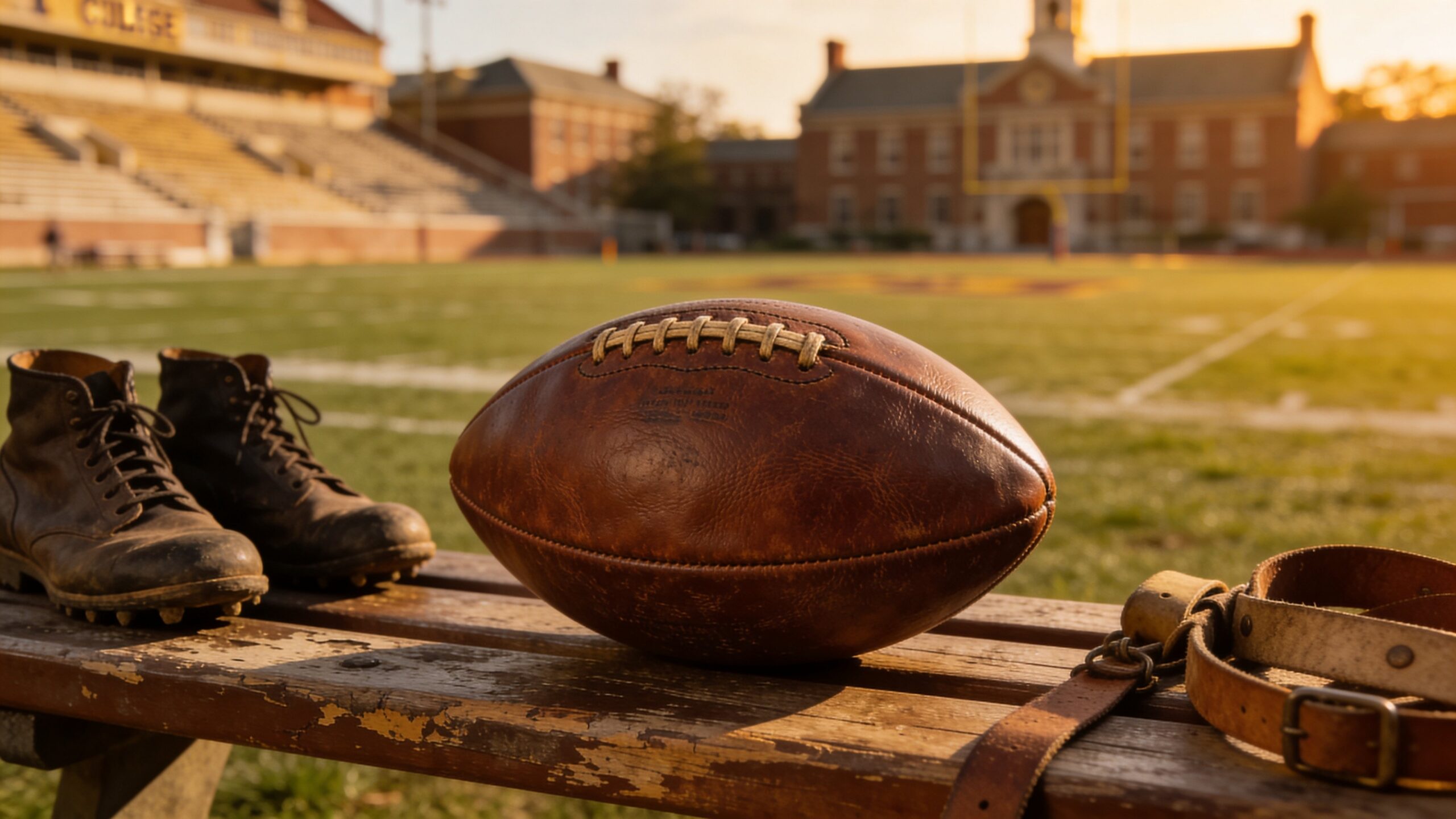
A League Born in Dust, Grit, and Uncertainty
The early days of the NFL were anything but polished. There were no glittering stadiums packed with luxury suites, no billion-dollar television deals, and no guarantee that professional football would even survive. What would eventually become America’s most powerful sports league began as a rough, unstable experiment held together by factory teams, barnstorming schedules, stubborn owners, and players tough enough to compete for modest pay and little recognition. In those first years, professional football was chaotic, regional, and often disorganized. Yet out of that uncertainty came the foundation of the modern NFL. In the beginning, football’s future seemed far less certain than baseball’s. College football dominated the public imagination in the early twentieth century, drawing prestige, crowds, and newspaper attention. Professional football, by contrast, was often dismissed as a lesser product, associated with industrial towns, working-class players, and clubs that appeared and disappeared with stunning speed. Still, the sport had something raw and compelling. It was violent, strategic, emotional, and deeply local. Fans in towns across the Midwest embraced teams that represented their industries, their neighborhoods, and their pride. Out of that environment, a league slowly emerged.
A: It began as the American Professional Football Association in 1920 before becoming the NFL in 1922.
A: Professional football first grew in industrial communities where local clubs already had strong support.
A: Yes, college football was far more popular and respected during the NFL’s early years.
A: Not always; many games were arranged flexibly, which could create uneven records and controversy.
A: Financial instability, travel costs, low attendance, and weak organization made survival difficult.
A: Stars like Jim Thorpe and Red Grange helped draw fans and media attention.
A: Many were not, and some worked other jobs because football pay was limited.
A: Loose rules, unstable teams, unclear championship systems, and constant financial pressure.
A: Famous survivors include the Bears, Packers, and Giants.
A: They show how the league’s identity was forged through struggle, improvisation, and survival.
The APFA and the First Attempt at Order
The NFL did not begin under that name. In 1920, a group of team representatives met in Canton, Ohio, to form the American Professional Football Association, or APFA. The goal was simple in theory but difficult in practice: bring some structure to a sport filled with bidding wars for players, unclear contracts, and inconsistent competition. Teams had been operating independently, often raiding one another’s rosters and scheduling opponents on the fly. A league promised standards, cooperation, and at least the appearance of stability. Canton was a fitting birthplace. Ohio was one of the hotbeds of early pro football, and the Canton Bulldogs were one of the strongest clubs in the country. Men like Jim Thorpe, the legendary athlete whose fame helped legitimize the new organization, gave the APFA a recognizable face. Thorpe was named the league’s first president, though the title was more symbolic than administrative. Real power remained scattered among owners, managers, and local interests. The APFA was still more of an agreement than a tightly controlled institution. Even so, the meeting mattered. It was the first serious step toward a national professional football structure. Teams from Ohio, Indiana, Illinois, and New York joined the fold, each bringing its own style, financial reality, and ambitions. In 1922, the APFA officially became the National Football League. The new name sounded bigger, more permanent, and more confident than the operation actually was, but it reflected what the founders hoped the league might become.
Small-Town Teams and Industrial Powerhouses
One of the most fascinating parts of the early NFL was how different it looked from the modern league. Today, NFL franchises are tied to major metropolitan areas and massive media markets. In the 1920s, many teams came from small cities and industrial communities. Canton, Decatur, Rock Island, Racine, Akron, and Hammond were not temporary side notes. They were central to the story. These clubs often had roots in factories, local athletic associations, or company-backed organizations. Football in those towns was woven into community life. A team was not merely entertainment; it was a badge of civic identity. The players were often local men or well-known regional athletes, and fans saw them as extensions of the town itself. That intimacy gave early pro football a flavor the modern game cannot fully replicate.
Some of the franchises that would become iconic had humble beginnings. The Decatur Staleys, backed by the A. E. Staley starch company, would eventually move to Chicago and become the Bears. The Green Bay Packers, founded in 1919 and sponsored by the Indian Packing Company, were one of the few small-town clubs able to survive long enough to become permanent fixtures. Their survival is one of the most remarkable achievements in sports history. In an era when teams folded easily and money was always scarce, Green Bay endured. Not every team was so fortunate. Clubs came and went with astonishing speed. Financial trouble, weak attendance, travel costs, and local competition could destroy a franchise almost overnight. Some teams lasted only a season or two. Others changed names, shifted locations, or merged with rivals. The standings themselves often looked unstable because the league was still figuring out how many games teams should play and how champions should be determined.
Chaos on the Schedule
The early NFL did not operate with the neat, balanced schedules fans know today. Teams often arranged games week by week, adding opponents as opportunities emerged. Some clubs played more games than others. Some faced strong opponents repeatedly, while others built records against weaker competition. Exhibition games against non-league teams also blurred the picture for fans trying to understand who truly belonged in the race for the championship.
Because of that looseness, controversy followed naturally. Championships in the early years were not always decided by a clean postseason system or even by identical records. League officials and owners often debated which team had the strongest claim. The famous 1921 dispute between the Buffalo All-Americans and the Chicago Staleys remains one of the league’s earliest dramas. Buffalo believed it had effectively secured the title, only for Chicago owner George Halas to arrange a late rematch and strengthen his club’s case. Whether viewed as shrewd strategy or opportunistic maneuvering, the episode captured the spirit of the era: ambitious, improvised, and rarely settled without argument. This disorder made the league exciting, but it also revealed its fragility. Fans could be confused by standings that were inconsistent and rules that seemed flexible. Owners could interpret agreements differently, and league authority was still weak. Yet each controversy also pushed the NFL toward greater structure. Out of disputes came the realization that the sport needed firmer scheduling rules, clearer governance, and stronger leadership.
Players Who Worked, Traveled, and Fought for Recognition
To understand the early NFL, it helps to picture the lives of its players. These were not modern stars with year-round training staffs and enormous contracts. Many players worked other jobs, endured punishing travel, and performed in a sport that offered little long-term security. Equipment was primitive by modern standards. Leather helmets provided minimal protection. Padding was thin. Medical care was basic. The game itself was brutally physical, and the conditions surrounding it were often harsh. Pay was modest, and fame was limited. Some players were known regionally, especially if they had strong college reputations, but the average professional football player did not enjoy the celebrity of college heroes. In fact, many people still viewed pro football with suspicion, seeing it as inferior or even morally questionable compared with the supposedly purer college game. That stigma mattered. The NFL was not only fighting for money and attendance; it was fighting for legitimacy. Still, the league attracted extraordinary toughness and talent. Jim Thorpe’s presence helped give the game star power. Red Grange, one of the most famous football players in America, transformed the league’s visibility when he joined the Chicago Bears in 1925. Grange’s arrival was a turning point because he brought college fame directly into the professional game. Crowds surged. Media attention increased. His barnstorming tour with the Bears helped show that pro football could draw national interest if marketed properly. Grange did not solve all of the league’s problems, but he proved that professional football could command attention beyond industrial towns and regional loyalists.
The Battle Against College Football
One of the greatest challenges facing the early NFL was the towering popularity of college football. In the 1920s, major college games were grand public spectacles. Universities had tradition, pageantry, alumni support, and established reputations. Newspapers covered them heavily. College stars were national celebrities. Against that backdrop, professional football often looked rough, improvised, and commercially suspect. The NFL had to convince fans that its product mattered. That was not easy. Early teams sometimes signed former college stars specifically to boost attendance and credibility. Owners understood that the public wanted recognizable names. But there was a tension at the heart of the strategy. The league needed stars to grow, yet it also needed a system and identity strong enough to survive beyond any single player.
The signing of Red Grange illustrated both the opportunity and the conflict. His transition to the professional game helped raise the league’s profile dramatically, but it also stirred controversy, especially among those who believed college players should not jump quickly into the paid ranks. At the same time, it showed owners that promotion, spectacle, and star-driven interest could help secure the sport’s future. The NFL was learning that survival required not just tough football, but business instincts.
Money Problems and the Constant Threat of Failure
Survival was never guaranteed. In the early years, professional football teams operated on thin margins. Attendance could swing wildly depending on weather, opponent quality, and local interest. Travel expenses were real burdens. Stadium arrangements were often imperfect. Many teams did not own their venues, and gate receipts could determine whether a club stayed alive another month. Economic instability shaped everything. Owners looked for affordable players, manageable travel, and attractive matchups. Some clubs scheduled games aggressively to generate income. Others cut corners wherever possible. The result was a league in which optimism and collapse existed side by side. One week a team might feel like a rising force; the next it might be unable to meet payroll or continue operations.
That instability explains why so many early franchises vanished. It was not always because the football was poor. Sometimes the economics simply made survival impossible. The NFL that eventually became powerful was built on the bones of many lost teams, many failed experiments, and many communities that loved the game but could not sustain it at the professional level. Yet the league kept going. That persistence is one of the defining themes of its early story. The NFL did not become dominant because it was instantly well designed. It became dominant because enough owners, players, and local supporters kept believing there was something worth saving. They endured losses, reorganizations, public skepticism, and internal disputes, and the league continued to adapt.
Rules, Identity, and the Search for a Better Game
As the league matured, it had to do more than stay alive financially. It needed a distinct football identity. The early pro game was heavily influenced by the college version, but the NFL gradually found ways to make its style more appealing and more sustainable. That process was slow, but crucial. Professional football could not simply be a lesser imitation of the college game. It needed its own character.
Rules and presentation were part of that evolution. The NFL eventually benefited from changes that opened up the game, clarified competition, and improved entertainment value. Passing would become more central in later decades, but even in the league’s formative years there was growing awareness that structure, scoring opportunities, and clean league administration would matter for public interest.
Leadership also became increasingly important. Men like Joe Carr, who became league president in the 1920s, helped impose greater order on the chaos. Carr understood that for the league to survive, it needed credibility, standards, and protection from the kind of free-for-all that had defined earlier pro football. He worked to strengthen franchises, stabilize schedules, and make the league look more professional. His role in turning the NFL from a loose association into a more coherent institution cannot be overstated.
The Teams That Endured and the Ones That Did Not
When people look back at the early NFL, they often focus on the famous survivors, especially the Bears, Packers, and Giants. Those teams matter because they became bridges between the league’s unstable birth and its later strength. Their stories reflect adaptation, strong management, and a bit of luck. They found ways to attract fans, establish recognizable brands, and remain viable when so many others disappeared.
The Chicago Bears, originally the Staleys, benefited from George Halas’s relentless energy and vision. Halas was not merely a coach or owner; he was one of the league’s great builders. He promoted the team, fought for league credibility, and helped shape the NFL’s business future. The Packers, meanwhile, became proof that a small-market team could survive through deep community support. The New York Giants, founded in 1925, brought big-city visibility that the league desperately needed. But the vanished teams are just as important to the story. They reveal how uncertain the league truly was. In another timeline, perhaps some other town becomes central and one of today’s flagship franchises disappears early. The early NFL was not inevitable. It was a contest against geography, economics, and public doubt. The teams that survived did so by navigating conditions that were often brutal.
Why the Chaos Mattered
The chaos of the early NFL was not merely a messy prelude to greatness. It was the furnace that shaped the league’s identity. Every unstable franchise, every disputed championship, every improvised schedule, and every financial scare forced professional football to confront what it needed to become. The NFL learned through hardship. It learned that strong administration mattered. It learned that stars could draw national attention. It learned that local loyalty was powerful, but not always enough. It learned that the game needed both toughness and spectacle.
There is something fitting about the fact that football, a sport built on collisions, emerged from such a turbulent struggle. The NFL did not glide into relevance. It absorbed blows and kept moving. That endurance became part of its mythology. The league’s founders and early figures were not operating in comfort or certainty. They were improvising in real time, trying to build a professional sport in a country that had not yet fully decided it wanted one.
From Survival to Foundation
By the end of its earliest era, the NFL was still far from the giant it would become, but it had done the hardest thing: it had survived. Survival meant more than simply continuing to exist. It meant establishing enough legitimacy, enough recognizable franchises, enough public interest, and enough organizational discipline to move forward. The league had weathered internal confusion, economic pressure, and fierce competition from college football. It had found builders, markets, and moments that kept it alive. That survival laid the foundation for everything that followed. Later decades would bring rule changes, championship games, television growth, national expansion, and cultural dominance. But none of that happens without the unstable, gritty, frequently chaotic first chapter. The NFL’s early days were filled with teams that disappeared, owners who gambled, players who endured, and communities that treated football as something worth fighting for. The story of the early NFL is compelling precisely because it was so uncertain. It was not a story of instant greatness, but of repeated rescue. It was teams and towns trying to make something permanent out of something fragile. It was chaos slowly turning into order. It was survival before success. And in that struggle, the foundation of modern professional football was built.