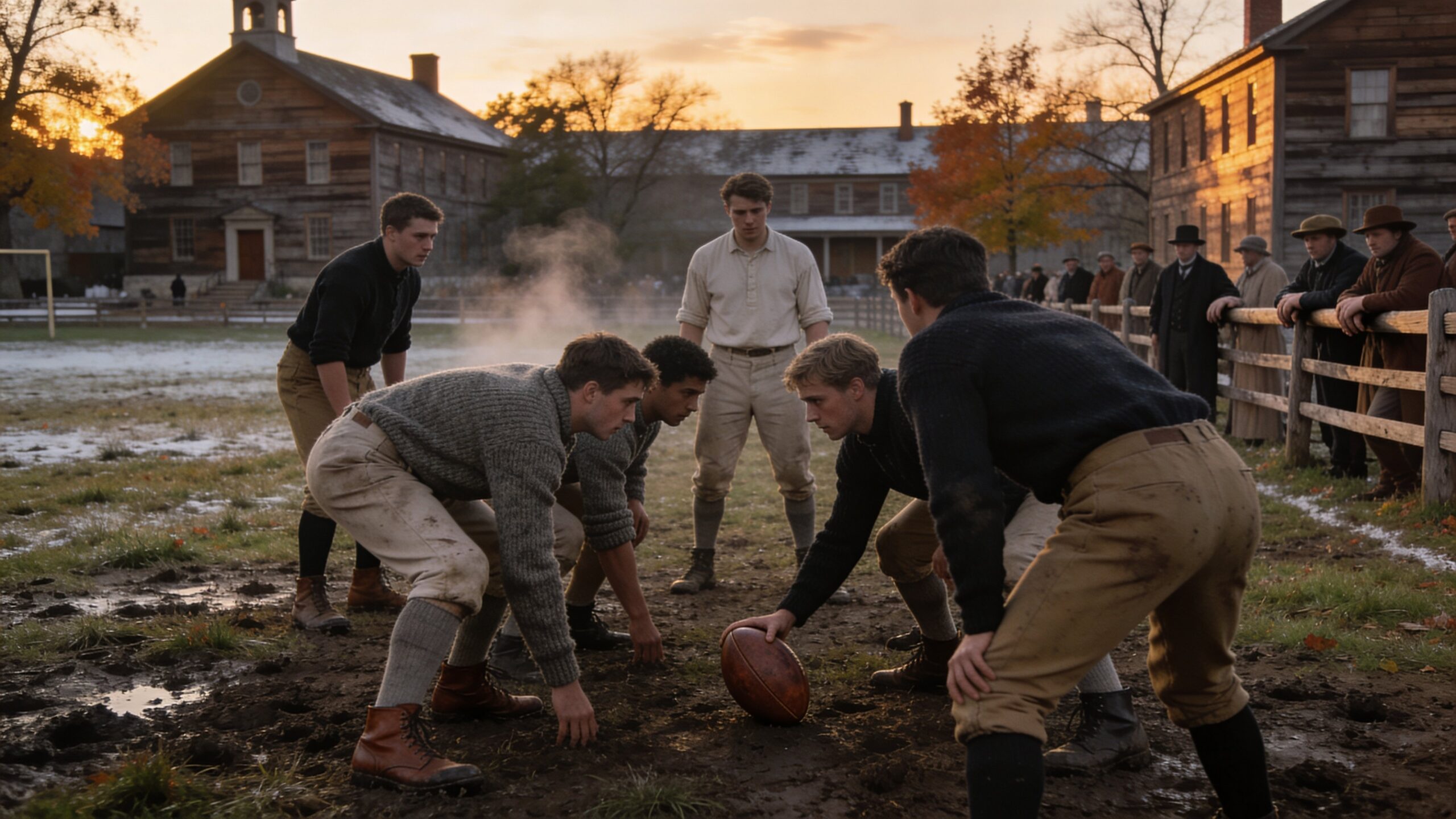
Who invented football? It sounds like a straightforward question. We ask it the same way we ask who invented the light bulb or the telephone. We expect a single name, a defining year, and a clear origin story. But football—whether you mean soccer or American football—does not fit neatly into that pattern. Football was not invented in a moment. It evolved over centuries. The modern game is the result of cultural traditions, schoolyard chaos, rulebooks, and reformers who tried to turn rough recreation into organized sport. To understand who invented football, we have to separate myth from history and look at how different versions of the game emerged across continents. Football is not the story of one inventor. It is the story of evolution.
A: No single person—modern rules were formalized in 1863 in England.
A: They played ball games, but not the modern codified sport.
A: Walter Camp helped shape its foundational rules.
A: Disagreement over handling the ball led to separate codes.
A: 1904, to oversee international football competition.
A: It derives from “association” football.
A: Yes, especially medieval mob versions.
A: British influence, trade routes, and international competitions.
A: Yes, safety and fairness updates continue today.
A: Historical splits created soccer, rugby, and American football.
Ancient Ball Games: The Prehistoric Roots of Football
Long before organized leagues or stadiums existed, civilizations around the world played games involving balls and feet. In ancient China during the Han Dynasty, a game called Cuju was played as early as the second century BCE. Players kicked a leather ball through a small opening in a net. The game was structured and even used for military training. In ancient Rome, a game known as Harpastum involved a small ball and physical contact. Though more closely related to rugby in style, it demonstrated that ball games involving teams and territory have long fascinated societies. In Mesoamerica, civilizations played ritual ball games that combined sport, ceremony, and spectacle. However, these ancient games were not modern football. They were ancestors in spirit, not in direct lineage. The rules, objectives, and equipment differed significantly. Yet they prove one thing clearly: humans have been drawn to competitive ball games for thousands of years.
Medieval Mob Football: Chaos in the Streets
If you traveled to England during the Middle Ages, you might have witnessed something closer to modern football—but far more chaotic. Known as “mob football,” these games were played between entire villages. The “field” could stretch across open land, through rivers, and into town centers. There were few rules, no referees, and plenty of broken bones.
The goal was simple: move a ball—sometimes an inflated animal bladder—to a designated location. Kicking, carrying, tackling, and grappling were all fair game. Violence was common. Kings attempted to ban the sport multiple times because it disrupted public order and distracted men from archery practice. Mob football was not yet organized football. But it showed that the basic idea—two teams competing to control and advance a ball—had firmly taken hold in English culture.
The Birth of Modern Soccer: Codifying the Rules
The true turning point in football history came in 19th-century England. As industrialization reshaped society, schools and universities began formalizing games. Each institution had its own rules. Some allowed carrying the ball. Others permitted only kicking. Confusion was constant when teams from different schools tried to play each other. In 1863, representatives from various clubs met in London to create standardized rules. This meeting led to the formation of the The Football Association. The FA established a uniform set of rules that prohibited handling the ball (except by the goalkeeper) and emphasized kicking. This was the official birth of modern association football—what most of the world calls football and what Americans call soccer. From that moment forward, football became a regulated sport. Fields were measured. Teams were limited to eleven players. The offside rule was introduced. The chaotic energy of mob football transformed into a structured game. The Football Association did not invent football from nothing. It codified it. It refined centuries of tradition into a sport that could spread worldwide.
Rugby and the Split from Soccer
Not everyone agreed with the FA’s restrictions. Some schools, especially Rugby School, preferred a version of the game that allowed players to carry and handle the ball. According to popular legend, a student named William Webb Ellis picked up the ball during a soccer match and ran with it, creating rugby.
Whether that story is fully accurate or partly myth, the split was real. In 1871, the Rugby Football Union was formed to govern the handling version of the game. From this divergence, two sports grew side by side: association football (soccer) and rugby football. Both shared common roots in English school games, but their rules and strategies diverged dramatically. This separation is critical in answering the invention question. Modern football exists in multiple forms because the original game fractured into distinct codes.
The Rise of American Football: Walter Camp’s Influence
When rugby spread to North America, it underwent further transformation. American colleges embraced rugby-style football in the late 19th century. Over time, rule changes reshaped the sport into something uniquely American. One name stands out in this transformation: Walter Camp. Often called the “Father of American Football,” Camp introduced key innovations while at Yale University. He established the line of scrimmage, the system of downs, and standardized scoring rules. Camp did not invent football from scratch. Instead, he engineered its American evolution. By the early 20th century, American football had become distinct from rugby, emphasizing strategy, formations, and set plays. Thus, if you are asking who invented American football specifically, Walter Camp’s contributions are foundational. But like his English counterparts, he was more architect than inventor.
The Role of FIFA and Global Expansion
Once rules were standardized in England, the sport spread rapidly across Europe, South America, and beyond. Sailors, merchants, and students carried the game to new continents. Local clubs formed. International competitions began. In 1904, the FIFA was established to govern international competition. FIFA unified rules globally and later organized the World Cup, which became the most watched sporting event on the planet.
FIFA did not invent football either. But it institutionalized and globalized it. Through organization and competition, football transformed into the world’s most popular sport. Today, billions follow the game. Stadiums hold tens of thousands. Television broadcasts reach every continent. All of it traces back to informal English school games refined in the 1800s.
Myth vs. History: Debunking the Single Inventor Idea
The biggest myth about football is that one person invented it. That story is appealing because it is simple. Humans like origin stories with heroes. But history is rarely that neat.
Football evolved. It was shaped by cultures, schools, reformers, and organizations. Ancient civilizations contributed early ball games. Medieval England preserved chaotic versions. Victorian reformers standardized rules. Administrators spread it internationally. Innovators adapted it into new codes like rugby and American football. The truth is less romantic but more fascinating: football is a collaborative invention spanning centuries.
Why England Gets the Credit
Although ball games existed globally, modern football’s standardized rules originated in England. The Football Association’s 1863 rulebook became the foundation for global adoption. English clubs were the first to organize leagues. The structure was exportable and clear. That is why England is widely credited as the birthplace of modern football. It is not because England invented the idea of kicking a ball. It is because England formalized and standardized the sport in a way that could be replicated worldwide.
Football’s Evolution into a Cultural Phenomenon
Once codified, football quickly moved beyond sport. It became culture. In South America, it became art and identity. In Europe, it became community and rivalry. In the United States, American football became a national spectacle. Professional leagues formed. Stadiums became landmarks. The World Cup united nations every four years. Football grew into a global language.
The invention question matters because it shapes how we understand ownership. But football belongs to no single nation anymore. Its modern structure may have English roots, but its identity is global.
Soccer vs. American Football: Two Different Inventions?
In the United States, the word “football” refers primarily to American football. Elsewhere, it refers to soccer. So who invented football depends on which version you mean. Association football’s rules trace directly to The Football Association in 1863. American football’s rules evolved from rugby under Walter Camp’s leadership in the late 1800s. They share ancestry but diverge in philosophy. Soccer emphasizes continuous play and fluid movement. American football emphasizes strategy, stoppages, and set formations. Both are football. Both evolved. Neither was invented in isolation.
The Power of Codification in Sports History
One of the most important lessons in football’s history is the importance of codification. Many games exist informally. But once rules are written, institutions formed, and competitions organized, a pastime becomes a sport.
The Football Association’s rulebook transformed local recreation into international competition. Walter Camp’s reforms transformed rugby-style play into a uniquely American spectacle. Codification, not inspiration alone, creates lasting sports.
Why the Legend of William Webb Ellis Persists
Stories like that of William Webb Ellis endure because they give sports mythology. Even if historians debate the accuracy, the narrative captures the spirit of experimentation.
Whether Ellis truly ran with the ball or not, rugby’s split from association football reflects a moment when players reimagined what the game could be. Myth adds color. History provides context.
Football’s Ongoing Reinvention
Even today, football continues to evolve. Rule changes address safety. Technology like VAR influences officiating. Player tactics transform strategy. The game in 2026 looks different from the game in 1926. Innovation never stopped.
The idea that football was invented once and frozen in time is inaccurate. It is constantly reinvented within its established framework.
So, Who Invented Football?
The honest answer is this: no single person invented football. Ancient cultures played early ball games. Medieval England preserved rough versions. The Football Association codified modern soccer in 1863. The Rugby Football Union formalized rugby in 1871. Walter Camp reshaped rugby into American football. FIFA globalized the sport.
Football is a layered invention. If pressed for a birthplace of modern soccer, England in the 19th century stands as the answer. If asked who shaped American football, Walter Camp is central. But neither created the sport from nothing. Football was not invented. It evolved.
Conclusion: A Game Shaped by Time
The story of football’s invention is not about a single genius or a dramatic eureka moment. It is about gradual refinement, cultural exchange, and institutional leadership. From ancient fields to medieval streets, from Victorian classrooms to massive international stadiums, football’s journey spans centuries. Understanding who invented football requires looking beyond myth and appreciating the historical process. It reminds us that the world’s most beloved games are rarely born overnight. They are built, shaped, and refined by generations. Football’s true inventor is history itself.